How do you propose in Paris without anybody spotting the photographer?
By deciding everything in advance — the exact spot, the exact minute, where the photographer stands and how you arrive — and then doing nothing unusual on the day.
Every failed surprise I have heard about failed for the same reason: something on the day was different. A detour that made no sense. A sudden interest in one particular bench. A person with a camera who kept looking over. The planning exists to remove all of that.
The proposal itself lasts about ninety seconds. Everything below is about the hour before it.
Where should you propose in Paris?
Somewhere you can stand still for two minutes without being moved along, with enough space for a photographer to be thirty metres away and unremarkable.
That second condition eliminates a lot of famous answers. A narrow terrace where a stranger with a long lens is obviously a stranger with a long lens does not work, however beautiful it is.
Trocadéro, at sunrise
The view everybody pictures, at the only hour it is actually available. By eight in summer the terrace is full; at six it is yours. The trade is the alarm clock, and it is worth it.
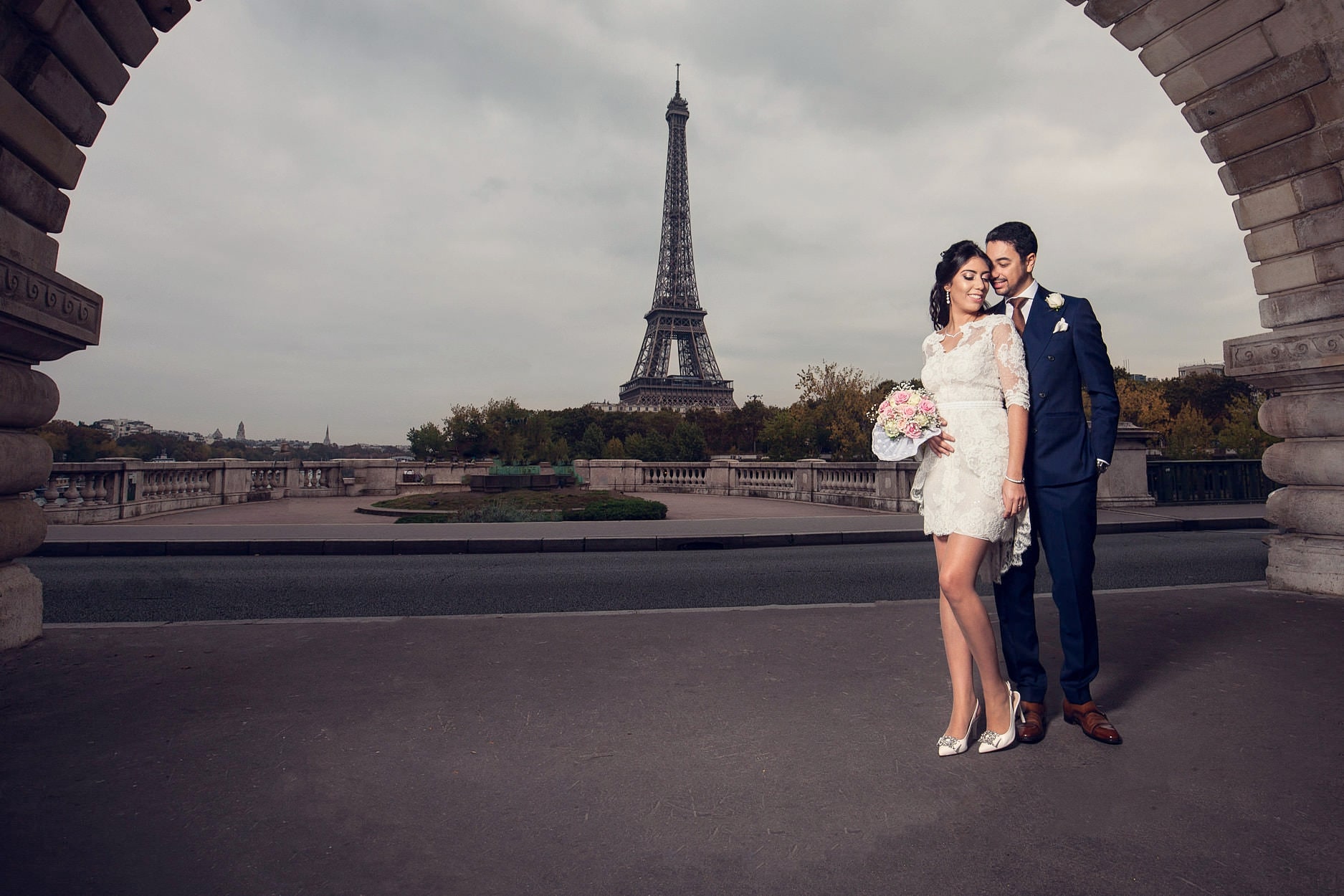
Pont de Bir-Hakeim
The arches frame the tower and, more usefully, they frame you. There is enough structure for a photographer to work from a distance without standing in open ground. It photographs as intimate rather than as a postcard.
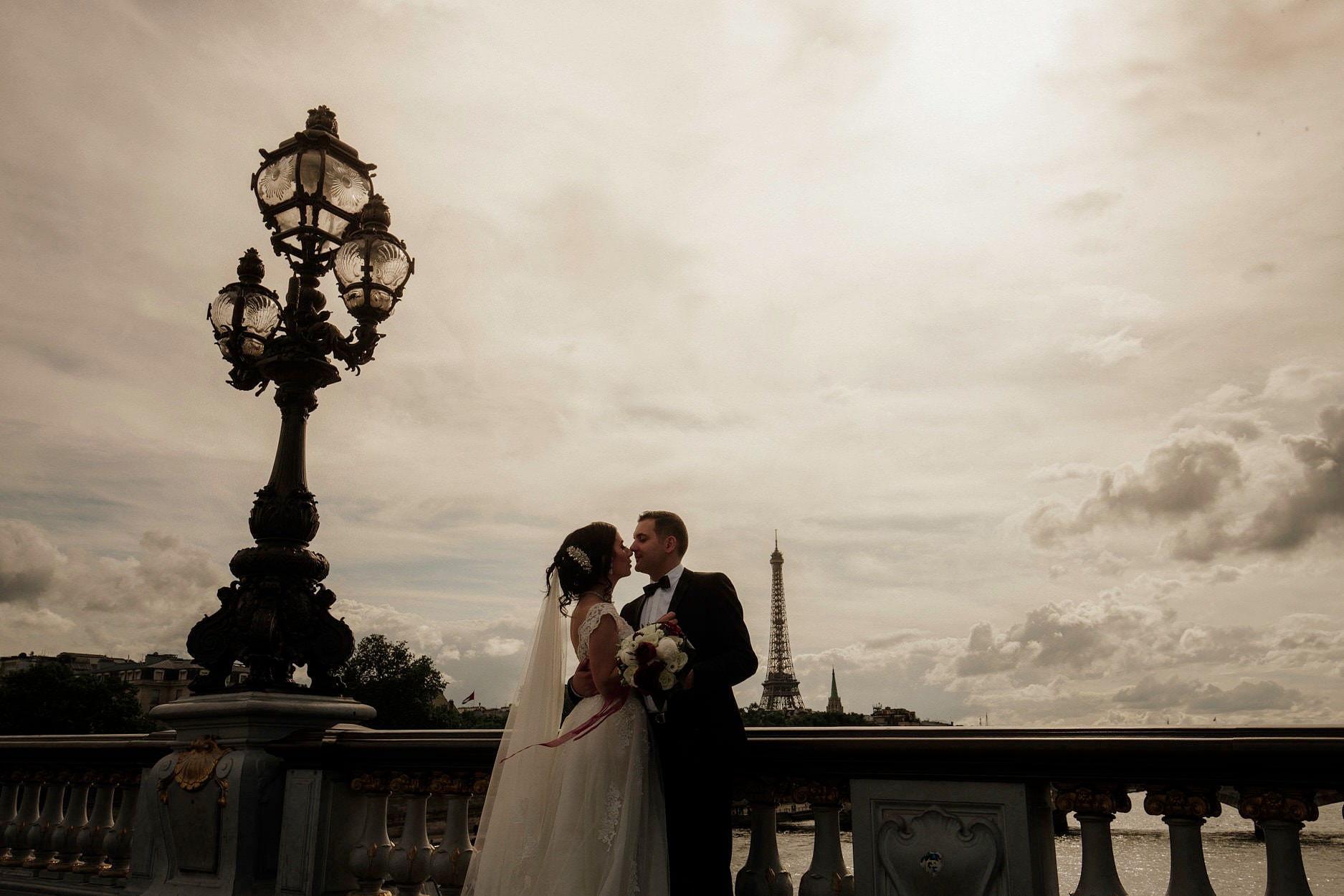
Pont Alexandre III
Wide, busy in a helpful way, and beautiful in almost any weather. A person photographing the bridge is the least remarkable thing on it. Good when the forecast is poor.
The Palais-Royal gardens
For couples who would genuinely rather not do the Eiffel Tower. Enclosed, formal, quiet, and completely Parisian without being the obvious answer. Arcades on all sides mean shelter and somewhere to stand out of the way.
Somewhere that means something to you
Better than all of the above, if it exists. The street where you stayed the first time. The café you always go back to. Nobody else will recognise it and that is rather the point.
What time of day should it happen?
Early morning, well before the crowds.
The hour after sunrise gives you three things at once: light that is low and warm, locations that are close to empty, and a much easier job hiding a photographer. The last hour before sunset gives you the light but not the other two — you are sharing the location with several hundred people and the light goes quickly.
If the surprise matters more than the sunset, take the morning. It is not a close decision.
Sunrise in Paris runs from about 05:50 in June to about 08:40 in December, so “sunrise” means very different alarms depending on the month. A December proposal at nine in the morning is in beautiful low light with almost nobody about, which makes winter far better for this than people assume.
How does the photographer actually stay hidden?
Distance, a long lens, and looking like everybody else.
I am usually thirty to sixty metres away. At that range, in a place where hundreds of people are photographing the same monument, a person with a camera is scenery. I do not carry anything that marks me out as working, and I am in position long before you arrive rather than walking in behind you.
The most common way this goes wrong is not the photographer being seen. It is the person proposing looking at the photographer. If you know where I am, you will check — everybody does. So I tell you the area I will be in, not the exact spot.
What is the signal?
Something you would do anyway.
It has to be visible from sixty metres and invisible to the person standing next to you. Things that work:
- Taking a hat or sunglasses off
- Putting one hand in a jacket pocket and leaving it there
- Setting a bag down on a specific step
- Stopping at an agreed point and turning to face the view
Things that do not work: waving, nodding at me, looking around for me, or checking your phone — because by then you are visibly doing something.
We agree the signal in advance and we agree what happens if you miss it. Usually the answer is that I keep photographing anyway; a proposal that starts a minute later than planned is not a problem, and I would rather have two hundred frames of you working up to it than none.
What can go wrong?
Rain, lateness, crowds, and nerves. In that order of frequency, and none of them are fatal.
- Rain. We photograph anyway. Wet Paris reflects every light in the city and the locations empty out, which helps more than the weather hurts. Bring one good umbrella rather than two bad ones.
- Lateness. Tell me. I will wait. A proposal that starts twenty minutes late is a scheduling problem; one where nobody warned the photographer is a lost photograph.
- Crowds. Why the hour matters more than the place. If a location has filled up, we move — which is why the plan includes a second spot within a two-minute walk.
- Nerves. You will do it earlier or later than planned, and it will not be where you intended. That is completely normal and it is the photographer’s job to absorb it.
What happens straight afterwards?
Twenty minutes of proper photographs, while it is still sinking in.
This is the part couples forget to plan and then value most. You are both slightly stunned, neither of you is thinking about the camera, and the photographs from that twenty minutes are almost always better than anything posed. It is also the first chance to introduce me, which is usually the moment the whole thing becomes funny.
Then you go and have breakfast, because it is half past seven in the morning and you have just got engaged.
What should you both wear?
Something you would wear anyway, in plain fabric, that you have already worn for a whole day.
The person being proposed to cannot be told to dress up, which is the constraint that makes this question interesting. So the answer is to engineer a reason: dinner somewhere good the night before, a morning walk you have talked about for weeks, a booking that justifies looking nice. Couples who try to solve it by asking their partner to wear a particular coat are the couples who get found out.
What photographs well in Paris is unfussy: long coats, plain colours, fabric that moves. What does not: large logos, busy prints, and anything brand-new that has not been walked in. Shoes matter more than people expect, because a proposal in the wrong shoes becomes a proposal that ends early.
Should anybody else be there?
Only if you have thought hard about it.
Family hiding behind a wall is a wonderful photograph and a genuinely risky plan. It doubles the number of people who can give it away, and it removes the option of quietly moving the whole thing twenty metres when the spot turns out to be busy. If you do want family there, they arrive after, not before — and somebody who is not you is responsible for them.
Friends who are “just happening” to be in Paris that morning is the version that works best. They are a plausible reason to be somewhere at seven in the morning, which solves your other problem at the same time.
How long does it all take?
The proposal is about ninety seconds. The whole appointment is usually an hour.
That hour covers me being in position well before you arrive, the approach, the proposal itself, and twenty minutes or so of photographs afterwards. It is short because it does not need to be long — the surprise is over quickly and the good light does not last.
What should you tell the photographer in advance?
More than feels necessary. Specifically:
- The exact spot, as exactly as you can describe it
- The time, and how firm it is
- How you will arrive, and from which direction
- What they look like and what they are likely to be wearing
- The signal, and the backup if you miss it
- Whether anybody else knows, and whether anybody else is there
- Whether you want the photographs shared publicly, or not at all
That last one matters. Nothing from a proposal appears on this website, on Instagram, or anywhere else without explicit permission. The default is that it stays private.
What to take from this
Choose the hour before you choose the place. Go early rather than at sunset. Agree a signal that is something you would do anyway, and then do not look for the photographer. Plan a second spot. Assume you will be nervous and do it in the wrong place, because you will, and it will not matter at all.