Where should you actually photograph a wedding in Paris?
Somewhere you can stand still for ten minutes without being asked to move on — which rules out most of the obvious answers in the middle of the day.
That is the whole problem in one sentence. Paris has perhaps twenty locations that photograph beautifully and about four hours a day in which they are usable. Everything below is organised around that, because a list of beautiful places without the hours attached is not useful to anybody planning a wedding day.
I photograph between two and four locations on a typical wedding day. Not ten. Ten is a route march, and it shows in the photographs, because by the fourth stop nobody is enjoying themselves any more.
What time of day actually works?
The first hour after sunrise and the last hour before sunset. Those are not a stylistic preference — they are the only times the light is low enough to be kind and the city is empty enough to work in.
Paris sits far enough north that this shifts a great deal across the year. Rough figures, worth checking against your actual date:
| Month | Sunrise | Sunset | What it means for a wedding day |
|---|---|---|---|
| June | around 05:50 | around 21:55 | Golden light until nearly ten at night. Sunrise portraits mean a 5 a.m. alarm. |
| September | around 07:20 | around 20:10 | The best month. Civilised hours at both ends. |
| December | around 08:40 | around 16:55 | The light is gone before the reception starts. Plan portraits for early afternoon. |
The December line is the one that catches people out. A winter wedding with a four o’clock ceremony has no daylight left afterwards, and no amount of planning recovers it. If you are marrying between November and February, the portraits have to happen before the ceremony or they happen in the dark.
Where do you go for the Eiffel Tower?
Three places, and they are not interchangeable.
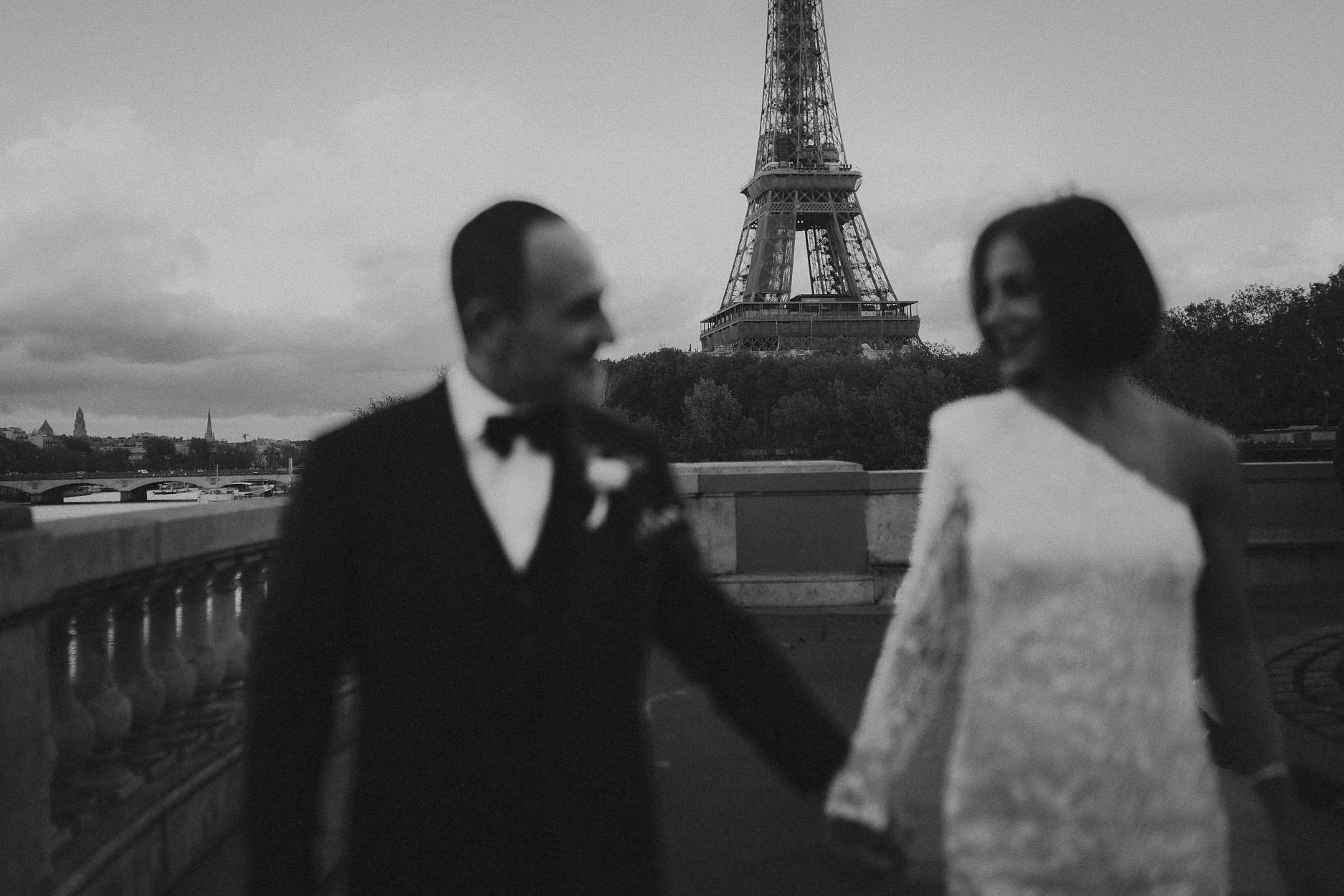
Trocadéro
The view everybody has seen, and for good reason — the terrace at Place du Trocadéro puts the whole tower in front of you with nothing in the way.
It is also, by mid-morning, one of the most crowded pieces of pavement in Europe. In summer it is genuinely full by eight. If you want the Trocadéro photograph, you are there at sunrise or you are not really there at all.
The lower terraces and the steps down towards the gardens are worth as much as the famous view and hold a crowd far better.
Pont de Bir-Hakeim
The bridge with the arches, and the more interesting answer. The stone and iron structure frames the tower rather than just pointing at it, and the columns give you somewhere to stand that is not the middle of a viewing platform.
It reads as intimate instead of as a postcard. It also has a working road and a Métro line above it, so it is loud — fine for photographs, less fine for vows.
Avenue de Camoëns
A short flight of steps off the Rue Raynouard with the tower straight down the middle. Small, quiet, almost always empty, and it does one photograph extremely well and then it is finished. Ten minutes, not an hour.
Which bridges are worth the time?
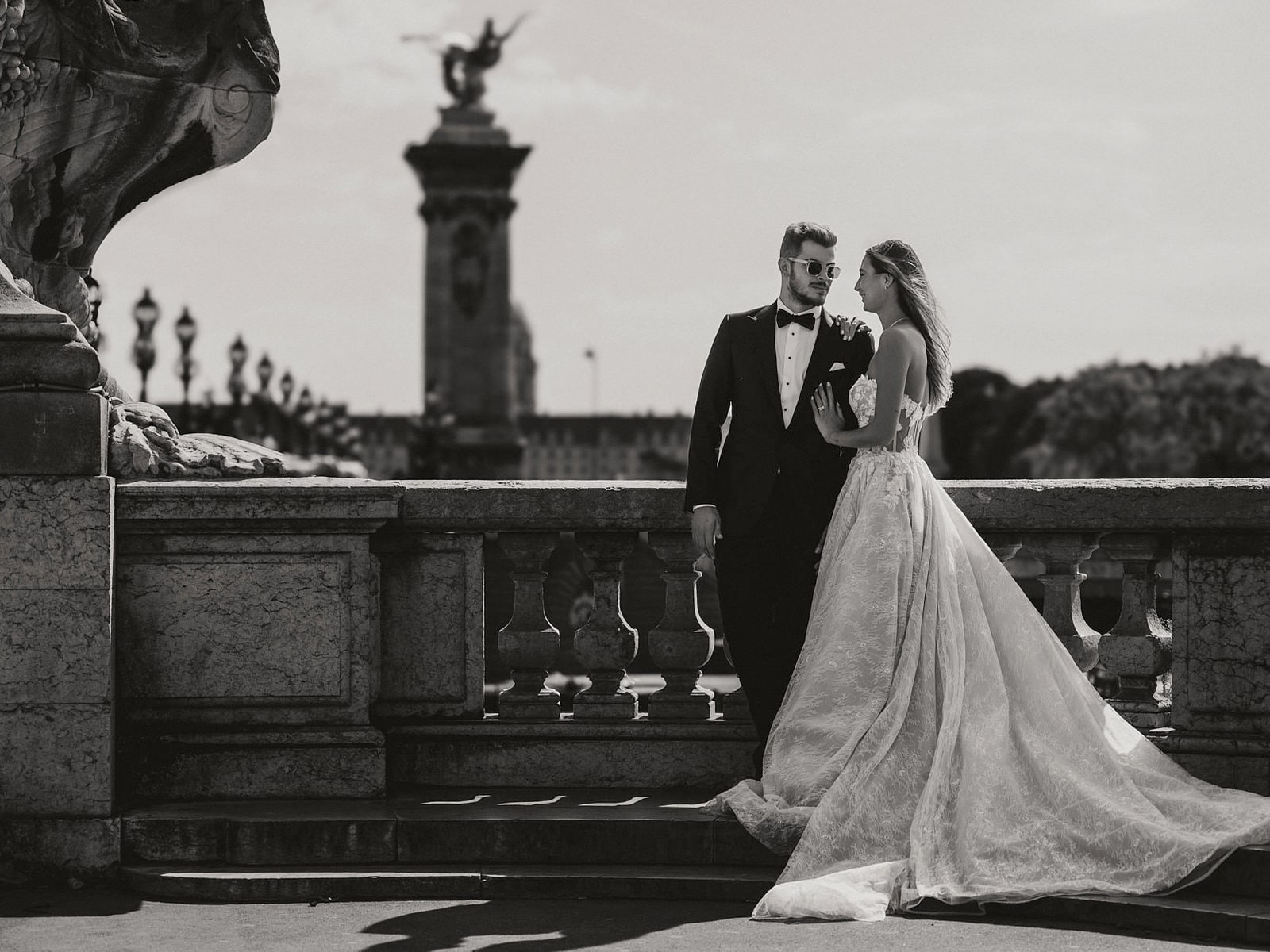
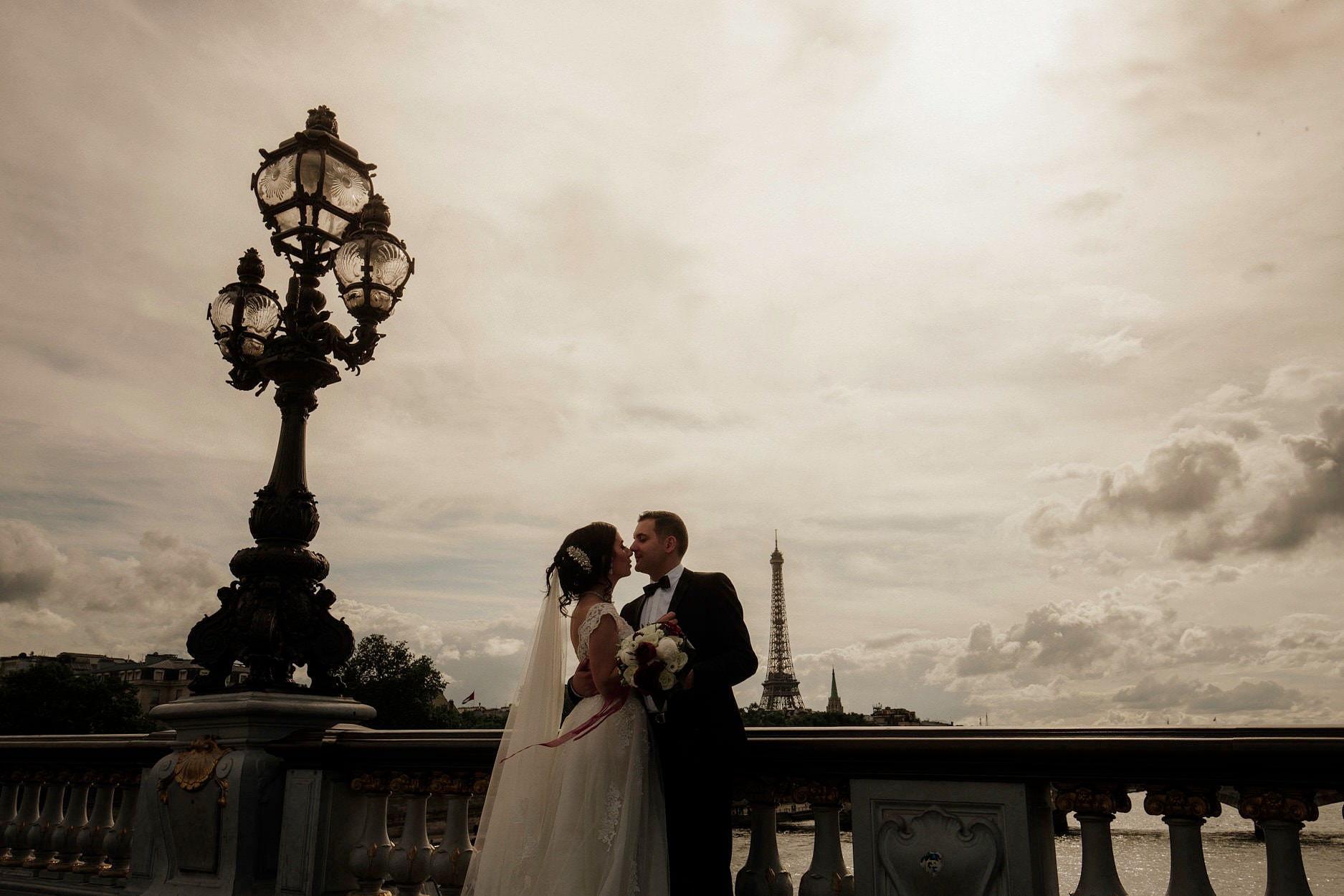
Pont Alexandre III, and after that the question is mostly about crowds rather than beauty.
The gilded lamps and the sculpture on Alexandre III photograph well in almost any weather, which is not true of much else in this city. Flat grey sky, low winter sun, rain — the bridge holds up. That makes it the reliable choice when the forecast has collapsed.
The catch is that everybody knows this. It is busy from mid-morning until dark, and in summer there is often more than one wedding party on it at once.
Pont Neuf and the Pont des Arts are quieter. The Pont Marie and the quays around the Île Saint-Louis are quieter still, and much more like the Paris people actually live in.
Where do you go when it rains?
Under something. Paris is unusually good at this, which is lucky, because it rains here about half the days of the year.
- The Palais-Royal — arcades on all four sides of the garden, so there is always a dry colonnade and always somewhere with light coming in from one side.
- The passages couverts — the Galerie Vivienne and the Passage Jouffroy are glass-roofed nineteenth-century arcades. Warm, dry, and they look like nowhere else.
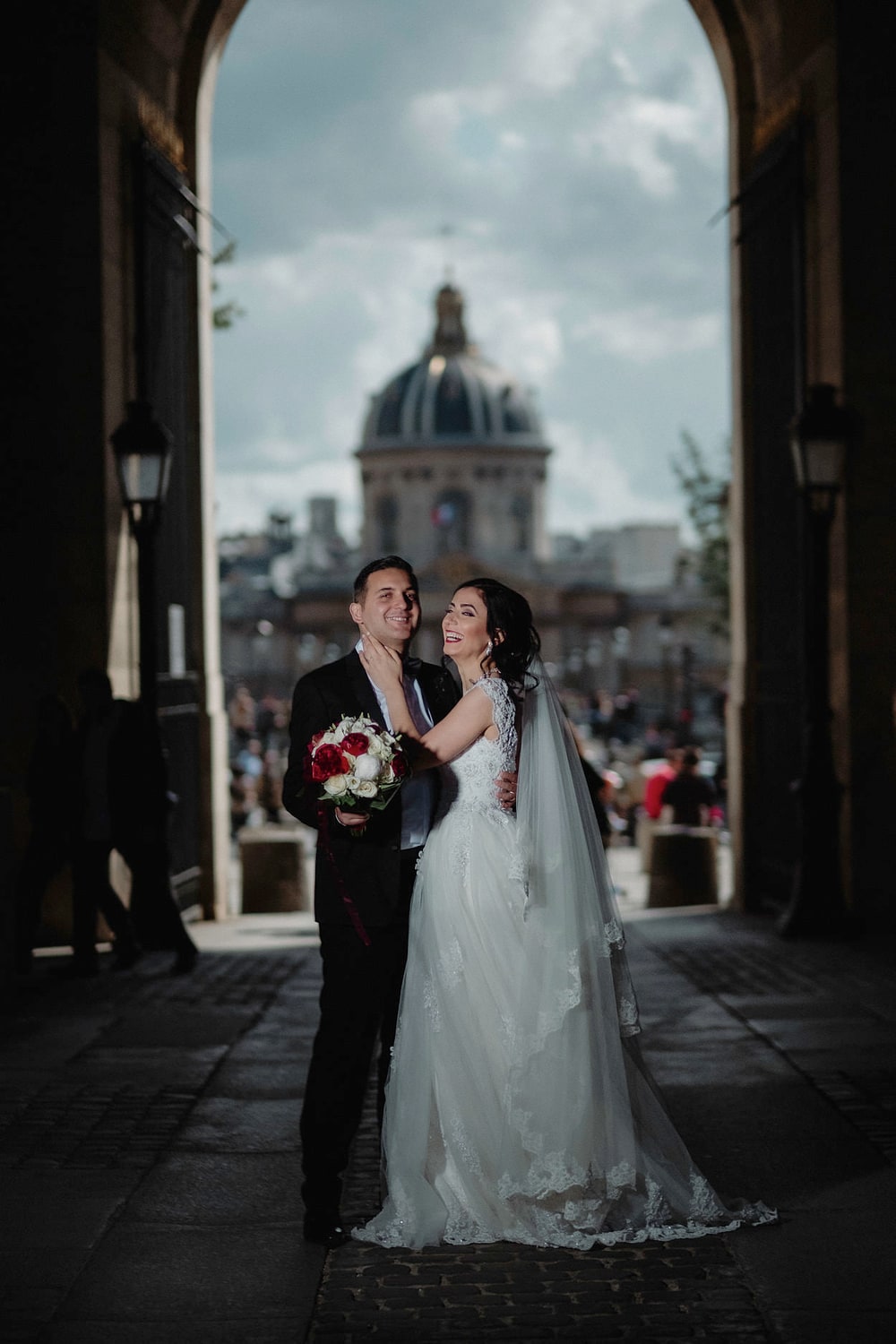
- The Louvre courtyards — the Cour Carrée and the arcades around the pyramid give you shelter and scale at once.
- The Métro — not a joke. Some of the older stations are beautiful and almost nobody photographs in them.
Wet cobbles reflect every light in the city, and an umbrella is a prop rather than a problem. Rain is not the disaster couples expect it to be. Wind is much worse, and nobody ever worries about wind.
Where do you go if you do not want the Eiffel Tower at all?
Plenty of couples do not, and the photographs are usually better for it.
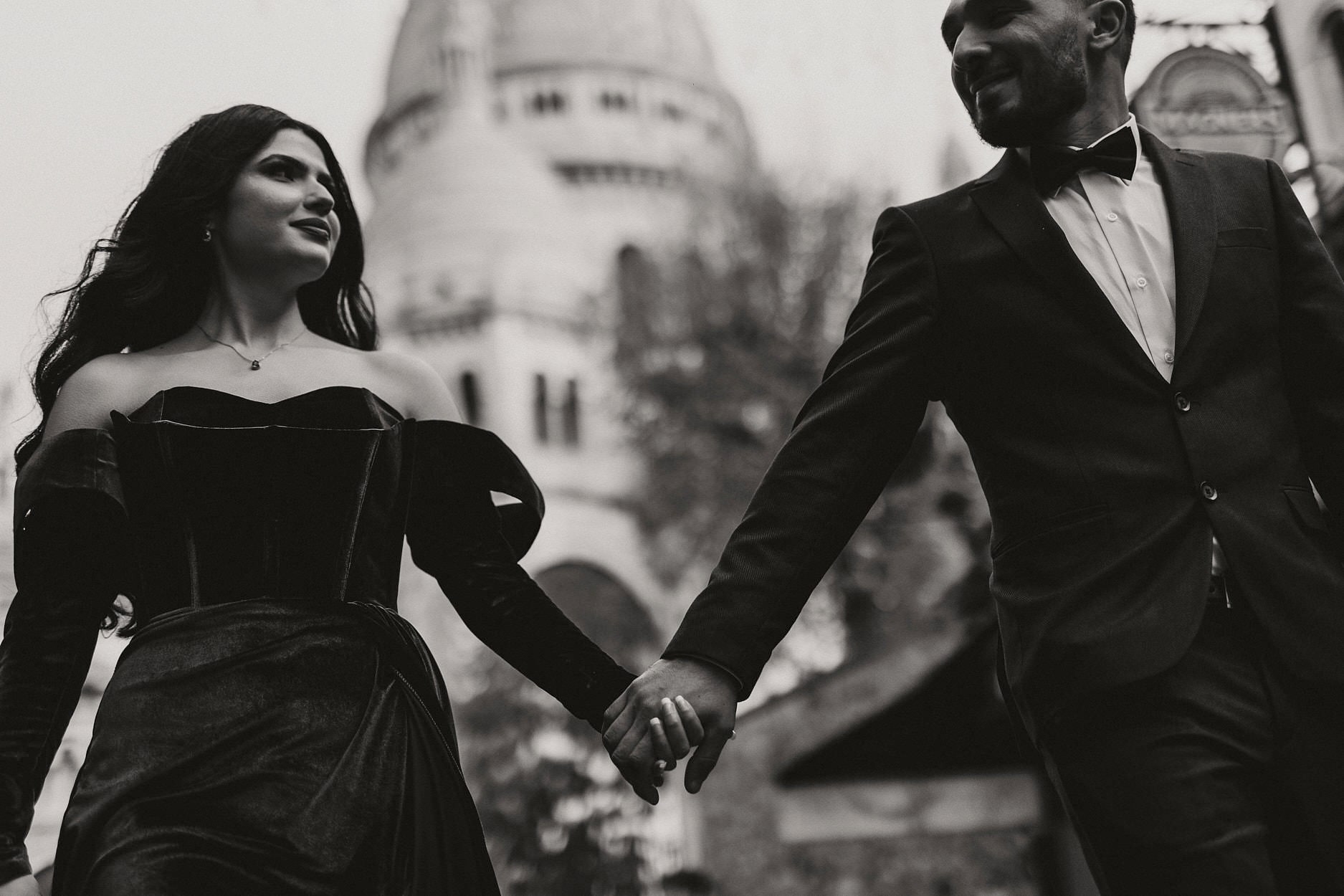
- Montmartre — steps, cobbles, narrow streets and one enormous white church. Extraordinary just after dawn and unusable by ten.
- The Marais — courtyards, painted shopfronts and stone. Good in flat light, which is when most of the famous locations stop working.
- Place des Vosges — arcades on four sides, a formal garden in the middle, and a great deal of shelter.
- The Luxembourg Gardens — formal planting, gravel, chairs, and space. Note that a commercial shoot in the Paris parks has its own rules, so this is a question for the venue rather than an assumption.
- The Île Saint-Louis — quiet, residential and entirely itself.
Do you need permission to photograph in Paris?
For an ordinary wedding party moving through public streets, generally no. For anything that looks like a production — lighting stands, tripods, a crew, blocking a path — the answer changes, and it changes by location.
The rough shape of it: on public streets, a photographer, a couple and a small group are not usually an issue. What changes the answer is scale and obstruction — a large crew, lighting stands, a drone, or a tripod planted where it blocks a pavement. In the Paris parks and gardens the rules are tighter than on the street, and a commercial shoot there is a question for the park rather than an assumption. Professional shoots that do need clearance go through the city, and applications are made well in advance rather than the week before.
The rules differ between the city, the parks, the monuments and the private venues, and they change. Treat the above as the shape of the thing and the venue as the authority.
There is one point worth knowing: the Eiffel Tower’s night-time illuminations are treated as a protected work, which affects commercial use of photographs of the lit tower after dark. The daytime structure is not affected. If this matters to you, ask before you plan an evening shoot around it.
How many locations can you realistically fit in?
Two on most wedding days. Three if they are close together and the day has room. Four is a fantasy that leaves everybody exhausted and produces worse photographs than two would have.
The arithmetic is unforgiving. Each location costs you the travel there, the finding of the right spot, ten or fifteen minutes of actually photographing, and the walk back. Call it forty minutes each in a city where crossing the river at six in the evening can take twenty. Two locations is an hour and a half of your wedding day, and that is usually the right amount.
A route that works
For a couple marrying in central Paris with an hour and a half for portraits, in September:
- Start at the mairie, or wherever the ceremony was, and photograph as you come out. This is the most emotional ten minutes of the day and it needs no location at all.
- One walk, somewhere within a few streets — a courtyard, an arcade, a good doorway. Unhurried.
- One view, timed for the hour before sunset. The bridge, or the tower, or the river, depending on what you actually care about.
- Back for the reception before anybody notices you were gone.
That is three stops, one of which is free because it is where you already are, and it does not eat the evening.
What to take from this
Pick the hour first and the location second. Choose two places, not five. Assume it will rain and know where you would go if it does. And be honest with yourself about which photographs you actually want — the tower is not compulsory, and the couples who skip it usually end up with the more personal set.